


Temperature & Humidity Monitoring
Where every degree matters.
Data centers run on the thinnest margins in critical infrastructure: 99.999% uptime, sub-degree thermal envelopes, and humidity windows just twenty points wide. Continuous, audit-grade temperature and RH measurement is what keeps your CRACs tuned, your DCIM honest, and your insurance underwriters quiet.
The stakes
Three failures that walk in through poor environmental data
Excursions and throttling
Even brief temperature spikes shorten server lifespan and trigger thermal throttling. ASHRAE's recommended envelope tops out at 27 °C, and by 32 °C, gear is at risk.
Static below, condensation above
Below 40% RH, static discharge corrupts drives and damages logic. Above 60%, condensation forms on cold surfaces and corrodes circuit boards. Both windows close fast.
A 1 °C drift can cost millions
Roughly 40% of a data center's energy footprint is HVAC. A 1 °C measurement drift across a fleet of CRACs can quietly add millions in cooling costs over a decade.
Where to measure
Three mounting positions cover every sensor zone
Modern data halls need temperature and humidity readings from three distinct points: above the racks, across the room, and inside the airstream. Each point demands a different transmitter form factor, and we stock all three.
Schematic cross-section. Cold aisle (blue) supplies up through the perforated floor; hot aisle (red) returns up to the ceiling plenum and back to the CRAC.
Specifying transmitters for hot/cold aisle layouts can be tricky.
Talk to a US-based engineer who actually knows this stuff.
Mounting Position 01
Ceiling-Mount Transmitters
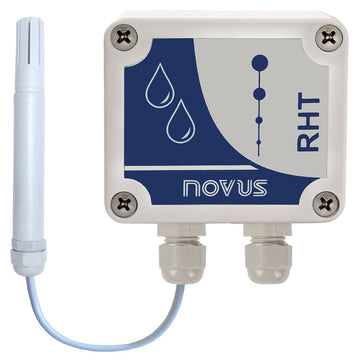
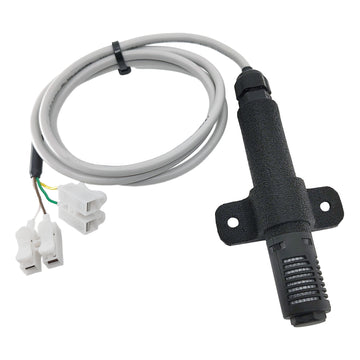
Compact analog probes that mount overhead, perfect for hot-aisle containment, drop-ceiling plenums, and rack-cabinet tops where wall surfaces aren't available and pulling Modbus runs is impractical.
The analog advantage. Most overhead T+RH probes on the market today are Modbus. That's great if you're commissioning fresh, but a hassle if you're feeding an existing BAS, PLC, or DCIM input that wants 4-20 mA. These two sensors give you that simpler, more universally compatible signal in a footprint small enough to tuck above any rack.
Mounting Position 02
Wall-Mount Transmitters
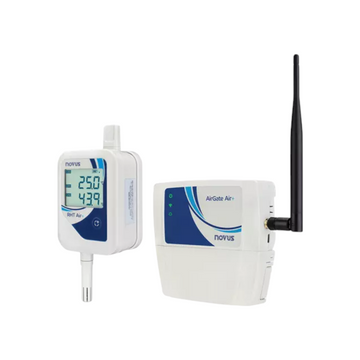
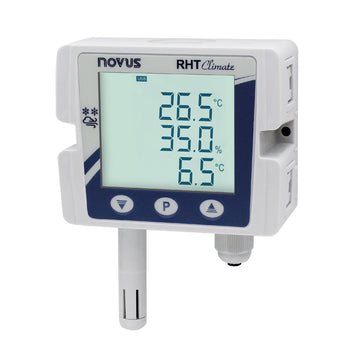
Zone-level ambient temperature and RH at server-rack height. Three options scale from sprawling multi-row halls to single-zone NOC walls.
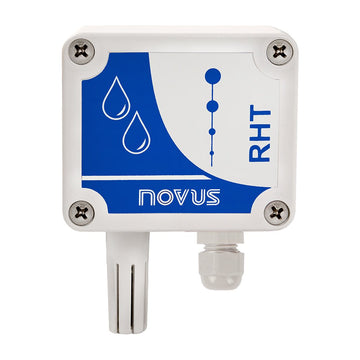
Three workhorses, three deployment styles. Climate Air+ is wireless and battery-powered, mounting via integrated magnets when running cable is impractical or you need 32 sensors on a 3 km LoRa network. RHT-Climate-WM is the wired go-to with optional LCD that lets a tech eyeball conditions at the rack, plus Modbus for bus consolidation. RHT-WM is the stripped-down loop-powered alternative when 4-20 mA is all you need.
Mounting Position 03
Duct-Mount Transmitters
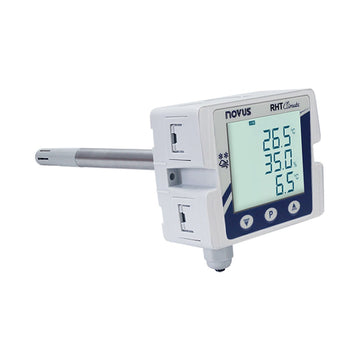
In-airstream measurement of CRAC/CRAH supply and return: the data your economizer logic and AHU controls actually act on.
Read the airflow, not the room. Wall-mount sensors miss the real thermal story; they read the room, not the moving stream. A duct-mounted probe sits directly in the airflow, so your dashboards reflect what the cooling equipment is actually delivering and returning. Critical for tuning CRAC setpoints and validating economizer behavior.

Why IOThrifty
Sensors built for sites that can't go offline
Field-replaceable sensors
Pre-calibrated sensing elements swap out in seconds with antistatic gloves. No downtime sending units back to the factory.
Multi-output flexibility
4-20 mA, 0-10 Vdc, and RS485 Modbus RTU available across the family. Mix and match per zone, per controller.
NIST-traceable calibration
Optional 6-point calibration certificates (3 RH × 3 temperature points) for FDA 21 CFR Part 11 audit trails.
A US engineer, by name
Same engineer answers your call every time. No menus, no scripts. Pick the right sensor with confidence the first time.
Not sure which sensor is right?
Talk to a US-based engineer who actually knows this stuff. They'll help you pick the right hardware or build a custom bundle.